How Riverside Iron Takes on Complex Fabrication Work
And wins high profile work
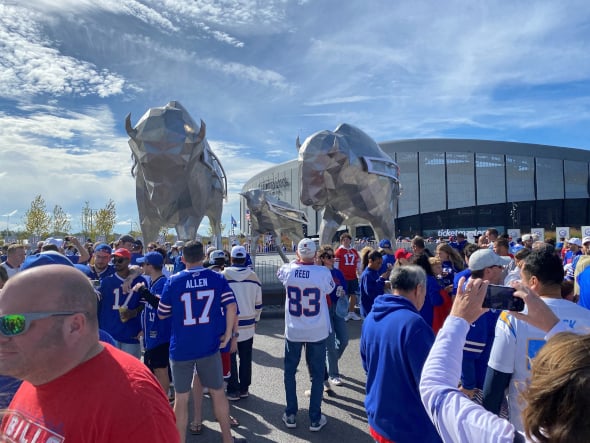
Hundreds of miles from the new Buffalo Bills stadium, a fabrication shop in Gouverneur, New York, helped bring one of the project’s most visible details to life. Riverside Iron LLC fabricated the intricate stainless steel grass blades surrounding the towering buffalo sculpture, combining careful planning, skilled craftsmanship, and Hypertherm cutting technology. For Riverside Iron, the project was more than a high-profile job. It showed what a fabrication shop can accomplish when experienced people, trusted relationships, and dependable technology come together.
The stadium project may have brought Riverside Iron national visibility, but the work itself was rooted in what the company does every day: solve difficult fabrication problems. “We’re a miscellaneous metals fabricator,” said Riverside Iron President Eric Tessmer. “We build stairs, railings, platforms, and custom fabricated components. Most of what we do is one-off work. Every project is different.” That custom mindset has shaped the shop and earned Riverside Iron a reputation for finding practical ways to build complex, one-off work right.
A Business Built on Relationships
Riverside Iron traces its roots back to 1962 and has served the region’s fabrication and construction industries for more than six decades. The company operates from an 11,000-square-foot facility and maintains a team that typically ranges from nine to fifteen employees depending on workload.
Tessmer became the company’s third owner in 2014 after spending more than two decades working throughout the structural steel and construction industries. “I had over 20 years on the road,” he explained. “I was born here in Gouverneur and wanted to come home and stay home.” He also brought the relationships that would eventually connect Riverside Iron to the Buffalo stadium project.
A former supplier connected Riverside Iron with Rommel Fence Company, which had secured fencing work for the stadium and needed a fabrication partner for the decorative grass blades surrounding the buffalo sculpture. The opportunity did not come from a sales pitch. It started the way a lot of good fabrication work starts: someone knew Riverside Iron could handle a difficult job and made the call.
Turning an Architectural Vision into Reality
The stainless steel blades circling the Buffalo Bills statue look simple enough. That is the trick. When fabrication work is done well, the finished piece hides everything it took to make it happen. Behind those clean lines were hundreds of unique components, tight tolerances, and a carefully planned assembly process, all completed without changing the designer’s vision.
The architect supplied the blade designs and dimensions. The challenge was finding a way to manufacture and assemble hundreds of unique components while maintaining a flawless appearance.
“We had zero artistic license,” Tessmer said. “The architect gave us the grass blade shapes, material requirements, and dimensions.”
The job called for approximately 392 half-inch thick stainless steel grass blades. Most were unique in height and shape, and every one had to fit around a 40-foot-diameter structure that dropped two feet from one side to the other. The geometry left little room for error.
The cut edges would remain visible after installation. If the quality changed from one blade to the next, visitors would see it. That level of visibility created pressure. Tessmer said, “There were so many unique parts, and if we made a mistake, it would have shown.”
Using ProNest from Estimating Through Production
Before Riverside Iron could price the work, Tessmer needed to know how efficiently the hundreds of unique blade shapes would fit on the stainless steel sheets. ProNest is Hypertherm’s CAD/CAM nesting software, used to arrange parts on a sheet and prepare jobs for mechanized cutting. Tessmer used it during estimating to calculate material consumption before the final drawings were complete, giving the shop a clearer basis for the quote. “I used ProNest in the estimate because I needed to understand how much material we were going to consume,” he said.
Once the drawings were approved, Hypertherm ProNest shifted from an estimating tool to a production tool. Riverside Iron’s detailing team created the CAD files, then imported them into the software to nest hundreds of unique parts, use the stainless steel efficiently, and prepare the job for cutting. That work helped the shop get more parts from each sheet and build an efficient cutting plan for hundreds of unique blades.
The difference was especially clear when Tessmer compared ProNest with the process he had used on earlier cutting systems.
ProNest made the process easier to run and easier to hand off, so the cutting workflow no longer depended on one person.
Hypertherm Plasma Delivers Architectural Quality
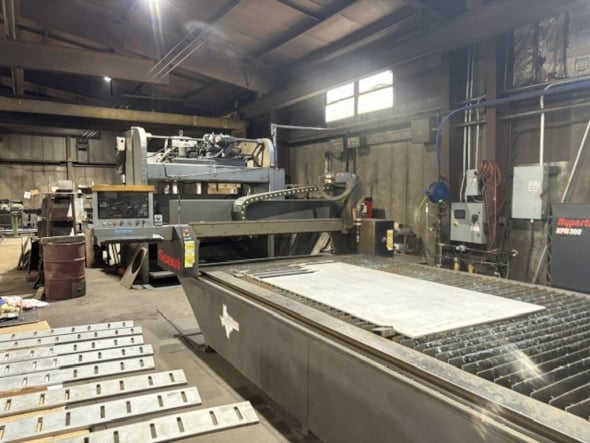
The blades were cut using a Lone Star cutting table equipped with a Hypertherm XPR300 plasma system. For a project where cut-edge quality would remain visible, many fabricators might automatically assume laser cutting would be required. Tessmer saw things differently. “A lot of people would have used a laser for this job,” he said. “But we did a lot of experimenting with different amperages and gases to find the right cut quality.”
Riverside Iron did not assume the first plasma settings would work. The team tested different amperages and gas combinations, then glass bead blasted the samples to see how the finished edges would look. They kept adjusting until the cut edge blended into the surface and delivered the architectural finish the project required.
“When the parts were blasted, the cut edge disappeared,” Tessmer said. “A lot of people think plasma leaves marks that you can never get rid of, but you can.”
That experience reinforced his confidence in Hypertherm technology. “As far as plasma goes, there’s no comparison to Hypertherm. Everybody knows that.”
Edge quality mattered, but Riverside Iron still had hundreds of different parts to move through the shop. Hypertherm Plasma helped the team do both.
The Hypertherm XPR300 also gave Riverside Iron a practical production advantage. Compared with oxyfuel cutting, plasma put less heat into the stainless steel, reduced distortion, and cut faster. That combination helped the shop hold the visible edge quality the project required while keeping hundreds of unique parts moving through production.
Precision Through Planning
Fabrication was only half the challenge. The completed blade assemblies also needed to fit together seamlessly once shipped to the stadium site.
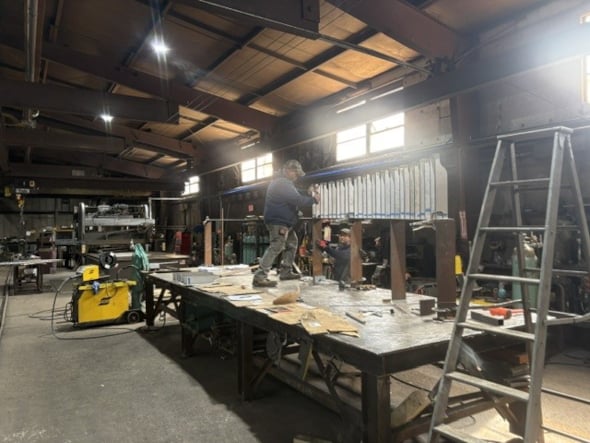
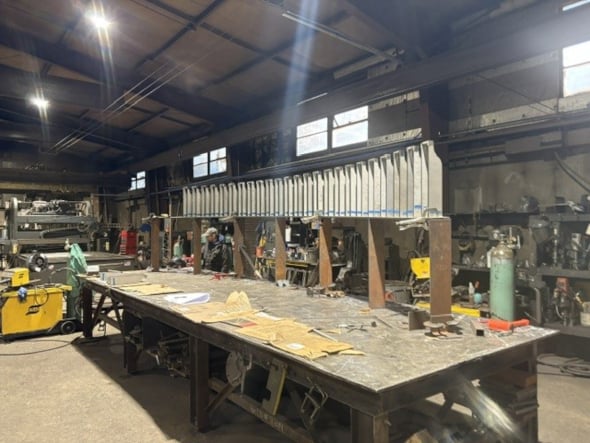
Riverside Iron built the installation geometry into the shop before the finished assemblies ever left Gouverneur. Using ProNest, AutoCAD, and the project drawings, the team created fixtures that matched the slope and elevation changes at the stadium. “We made supports in the shop that duplicated how the pieces would sit in the field,” Tessmer explained. Workers could place three adjoining assemblies together, check the transitions, and correct any mismatch before shipment.
The team checked three adjoining assemblies at a time, giving workers enough context to catch a mismatch before the parts left the shop. “We always had three pieces together at one time so we could see how they matched each other. That way there wouldn’t be any surprises.” The planning paid off. When the assemblies reached the stadium, the pieces matched and the transitions disappeared into the finished installation.
Supporting Critical Infrastructure
While the Buffalo stadium project has attracted attention, it represents only one part of Riverside Iron’s business. Today, the company focuses heavily on hydroelectric infrastructure and electrical transmission projects throughout the Northeast. Riverside Iron manufactures trash racks for hydroelectric facilities, fabricates substations for utility providers, and supplies platforms, railings, and support structures for industrial customers.
The stadium work demanded clean visible edges and exact fit-up. Riverside Iron’s hydroelectric and utility work demands the same discipline, even when the finished parts are far less visible. The work changes, but Tessmer’s approach does not. Put experienced people on the job, plan the process before cutting starts, and use equipment the shop can trust. “It’s a small world,” he said. “If you do a good job and people know they can depend on you, word gets around.”
For Riverside Iron, the stadium project proved that a small shop can take on nationally visible work without losing the practical habits that built its reputation. Plan carefully. Test the process. Trust the people doing the work. With Hypertherm plasma technology and ProNest software supporting that approach, Riverside Iron is ready for the next difficult job that comes through the door.