Why More Fabricators Are Rethinking Gouging
Gouging Has Become a Productivity Problem
Gouging is rarely the part of the job anyone talks about first. It usually happens somewhere between cutting, welding, inspection, repair, and getting the work out the door. But when unwanted metal has to be removed before the next operation can happen, gouging becomes a real productivity issue.
For decades, many fabricators have relied on carbon arc gouging, grinding, oxyfuel, or some combination of the three. These methods work. That is not up for debate. The question is how much time, cleanup, noise, operator fatigue, and secondary work shops are willing to accept along the way. Given how much cleaner, more controllable, and easier to integrate plasma gouging has become, plasma is now a clear option for fabricators looking for a practical way to remove metal without adding unnecessary work after the gouge is finished.
As shops deal with labor shortages, tighter delivery expectations, and pressure to improve throughput, processes that used to be accepted as “just part of the job” are getting a second look. Gouging is one of them.
The Hidden Cost Is Usually What Happens Afterward
When shops compare gouging processes, they often focus on how quickly each method removes metal. That matters, but it is only part of the story. A process can remove material quickly and still slow the job down if it requires heavy cleanup, an inconsistent gouge profile, difficult slag removal, or a surface that needs grinding before welding.
That is where the actual cost becomes harder to see. The gouging operation may only take a few minutes, but the work that follows can stretch much longer. If an operator has to grind, smooth, inspect, and correct the area before moving on, then the real cost is not limited to the time spent over the arc.
This is where Hypertherm plasma gouging starts to make a stronger case. Plasma gouging can produce cleaner, more controlled gouges and reduce the amount of secondary grinding required afterward. That matters because the value of gouging is not just removal. It is readiness. The faster a part or weldment is prepared for repair, welding, or inspection, the faster the job can move through the shop.
Across one repair, that may not seem like a major difference. Across dozens or hundreds of jobs, those small gains become meaningful. Less grinding means less hazard exposure that results in operator fatigue, strain, hearing loss, and eye injuries. Cleaner gouges mean less rework and weld prep. More consistent preparation means fewer delays between operations. More accurate gouging for full penetration welded joints can reduce time, wire, and improve quality.
Carbon Arc Still Works, But It Brings Baggage
Carbon arc gouging has been used for decades because it can remove metal aggressively in demanding environments. Many shops know the process well, and many operators have built skill around it. But familiarity can make the drawbacks easier to overlook, especially when the work that follows the gouging has become just as important as the gouge itself.
That is where carbon arc starts to lose ground. It can be loud, smoky, and harder to control, and it can introduce carbon contamination that requires additional cleanup before welding. The process may remove metal quickly, but speed at the gouge does not always translate into speed through the full job.
That is why plasma has become the stronger option for many modern fabrication and repair workflows. It gives shops a cleaner, more controlled way to remove metal while reducing the noise, fumes, grinding, and rework that can slow the job down after traditional gouging is finished. Plasma is also much easier to automate. When operating on a CNC table, tractor or robotic arm, the plasma gouges are more uniform and smoother and can be larger than a single pass gouge profile if a weaving motion is applied.
Plasma Gouging Solves More Than Metal Removal
This is where plasma starts to separate itself. The strongest argument for Hypertherm plasma gouging is not simply that it is another way to gouge. It is that it can solve several production issues at the same time. Compared with traditional methods, plasma gouging can deliver cleaner, more consistent gouges while reducing grinding afterward. It can also reduce noise, lower fume generation, eliminate carbon contamination risk, and work across a broader range of materials. For shops trying to move work faster with less cleanup and fewer process headaches, plasma is the better answer.
Hypertherm plasma gouging reduces the time that slows jobs down after the gouge is finished. A shop may start looking at it because it wants less grinding, but the larger value shows up across the workflow. Less cleanup can mean faster weld prep. A more controlled gouge can mean less rework. Lower fumes and noise can improve the working environment, which may also help shops attract and retain skilled workers.
Plasma gouging is not just a different way to remove metal. For many shops, it is the cleaner, more productive way to get repair and fabrication work ready for the next operation.
Why Simplicity Matters More Than Ever
A better gouging process still has to be practical on the shop floor. If it is difficult to set up, hard to teach, or too dependent on one experienced operator, the productivity gains can get lost before the work even starts. Shops need tools that help more operators get consistent results without adding unnecessary complexity. That is one area where Hypertherm has built a strong reputation. Powermax systems give fabricators a portable platform capable of both cutting and gouging, so shops can support fabrication, repair, maintenance, and field work with one system.
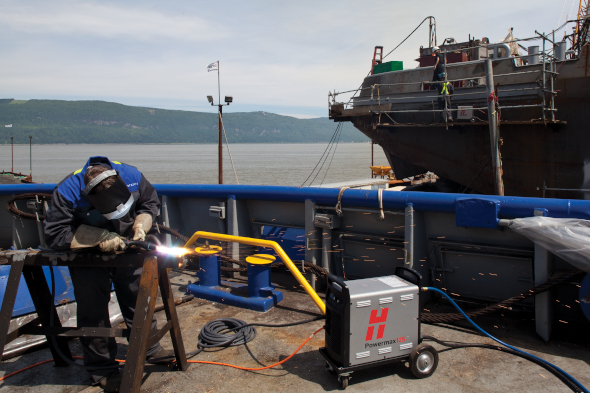
Powermax SYNC simplifies the process further through cartridge-based consumables that automatically configure the system for the application being performed. For gouging applications, operators install the appropriate green cartridge and get to work. On a busy shop floor, reducing setup time and minimizing mistakes can matter as much as gouging speed.
The reality is that many manufacturers are not looking for more complicated tools. They are looking for tools that make it easier to achieve good results day after day. When a Hypertherm system helps reduce guesswork and makes it easier for operators to move between cutting and gouging, it supports the kind of flexibility many shops need.
Where Hypertherm Fits
A small fabrication shop and a shipyard may both need to gouge, but they are not solving the same problem. One may need a portable system that can move from a repair bench to the field. Another may need the duty cycle, consistency, and control to support heavy industrial work. That is why Hypertherm’s role in gouging is not built around one narrow use case. It is built around giving different types of operations a practical plasma option that fits the way they actually work.
Powermax systems provide portable cutting and gouging capabilities for flexible shop work, while larger, higher power systems such as the MAXPRO200 and XPR series support demanding industrial applications where duty cycle, productivity, large gouge profiles and consistency become more important.
For a small shop, the value may be a portable Hypertherm system that can cut and gouge without adding another piece of equipment to the floor. For a repair operation, the benefit may be faster weld removal and less cleanup. For a larger manufacturer, the opportunity may be improved consistency, automation, and better control over weld preparation.
Different shops will care about different parts of the value proposition, but the larger goal remains the same: making gouging cleaner, simpler, and more productive without completely rethinking how work moves through the shop. For the shop, no matter the size, that means less disruption, faster movement from gouging to the next operation, and a process that supports production instead of slowing it down.
The Future of Gouging Is Workflow
Gouging has always been about removing unwanted metal. What has changed is how manufacturers measure success. The question is not only how fast metal can be removed. It is how quickly the part can be ready for the next step, how much cleanup is required, how easy the process is to teach, and how much noise, smoke, and operator fatigue are built into the job.
That is why plasma gouging continues to gain attention. It gives fabricators a way to look beyond the gouge itself and focus on the complete workflow. Less grinding, cleaner preparation, better control, broader material capability, and automation potential all help remove obstacles between the problem and production.
For shops already comfortable with plasma cutting, gouging may be one of the most underutilized capabilities in the building. For shops still relying on traditional methods, it may be time to ask whether the old way still fits the work ahead.
Hypertherm plasma gouging solutions give fabricators a practical way to answer that question without starting from scratch. The goal is not to replace every gouging method in every shop. The goal is to help manufacturers and fabricators choose the process that gives them the best combination of speed, control, consistency, automation ability, safety, and productivity for the work they actually do.
FAQ
Why are more fabricators switching to plasma gouging?
Many fabricators want to reduce grinding, improve workflow efficiency, create cleaner gouges, and minimize the noise, smoke, and cleanup associated with traditional gouging methods.
Is plasma gouging meant to replace carbon arc gouging?
Not necessarily. Carbon arc gouging remains proven in many heavy industrial applications. Some manufacturers are adopting plasma gouging because it can provide cleaner results with less secondary work, lower contamination risk, and a more comfortable working environment.
What makes plasma gouging more productive?
The biggest productivity gain is often found after the gouging operation is complete. Cleaner gouges and reduced cleanup can help move parts to the next operation faster while reducing the labor tied to secondary grinding, correction, and rework.
Can the same plasma system cut and gouge?
Yes. Many modern plasma systems are designed to perform both cutting and gouging, allowing operators to switch between processes without changing equipment. This can be especially useful for fabrication, repair, maintenance, and field work where flexibility matters.
What industries commonly use plasma gouging?
Plasma gouging is used in fabrication, structural steel, shipbuilding, rail, heavy equipment repair, manufacturing, mining, agriculture, and general maintenance applications.
Why is Powermax SYNC popular for gouging applications?
Hypertherm Powermax SYNC simplifies the gouging process through cartridge-based consumables that help configure the system for the application being performed. For many shops, that simplicity reduces setup complexity, shortens the learning curve, and helps operators achieve more consistent results.
Can plasma gouging be automated?
Yes. Plasma gouging can be integrated into automated systems such as CNC tables, track based solutions and robotic arms. This makes it attractive for manufacturers looking for greater consistency, improved throughput, and reduced operator exposure to difficult, hazardous or repetitive gouging work.