What Does “Weld Ready” Mean
and Why it Matters for Plasma Cutting
In most fabrication shops, grinding is treated as part of the process. Parts come off the table, operators clean the edge, and only then do they move to welding.
Hypertherm high-definition plasma cutting systems challenge that assumption. With the right setup, a plasma cut edge can move directly from the cutting table to the welder with no secondary preparation.
This is the concept of “weld ready.” Little to no grinding. No rework. No interruption between cutting and welding.
For high-volume fabrication, this shift is not minor. It changes how work flows through the shop. Instead of relying on time consuming manual cleanup, edge quality is built directly into the cutting process, where it can be controlled and repeated. More importantly, it introduces consistency. Every part comes off the table with the same edge condition, reducing variation downstream.
Achieving weld-ready results consistently is not the result of a single factor. It depends on system capability, parameter discipline, gas selection, and consumable condition. When those inputs are aligned, plasma cutting becomes a reliable, repeatable process that produces edges ready for welding at scale.
What “Weld Ready” Actually Means
“Weld ready” is not a formal specification. It is a practical condition that allows a part to be welded immediately after cutting without additional edge preparation.
A weld-ready plasma cut edge meets the following criteria:
- No dross or slag on the bottom edge
- No contamination that would interfere with weld quality
- Accurate geometry for consistent fit-up
- A clean surface that supports proper weld fusion
When these conditions are met, the welding process becomes more predictable. Fit-up improves, weld quality is more consistent, and throughput increases because prep work is removed from the process.
Why Weld Readiness Matters in Production
The impact of weld readiness is rarely measured directly, but it affects multiple parts of the operation.
Labor and throughput
Manual grinding adds time to every part. On simple components, the impact may be small. On complex assemblies, it can add significant labor per part. Over the course of a shift, that becomes hours of non-value-added work.
Weld-ready plasma cutting shifts that time upstream. Instead of manual cleanup, the system produces a consistent edge automatically.
Process consistency
One of the biggest advantages of high-definition plasma systems like Hypertherm XPR is consistency. Cut quality remains stable across parts, operators, and shifts.
Manual grinding introduces variation. Plasma systems, when properly set up, remove that variability by producing repeatable edge quality directly at the source.
Material and fit-up control
Over-grinding removes material and can affect tolerances. In tight-fit applications, this creates gaps and alignment issues that translate into inconsistent welds.
A consistent plasma edge improves fit-up and reduces downstream adjustments.
Consumable and operating cost
Grinding consumables add ongoing cost. Eliminating or reducing grinding shifts cost out of manual processes and into a controlled cutting operation, where outcomes are more predictable and scalable.
What Prevents Weld-Ready Plasma Cuts
Plasma cutting is capable of producing weld-ready edges, but several factors can prevent consistent results.
Dross formation
Dross is the most visible barrier to weld readiness. It forms when molten material is not fully ejected from the kerf.
High-speed dross is bonded and requires grinding.
Low-speed dross is softer but still requires cleanup.
Correct parameter selection is critical. Hypertherm cut charts are designed to achieve optimal edge quality with minimal dross. When followed closely, they enable consistent, repeatable results.
Nitride layer formation
When air or nitrogen is used as the plasma gas, a nitride layer can form on the cut surface. This is primarily a concern for applications such as TIG welding, where sensitivity to contamination is higher.
For carbon steel, oxygen plasma is the preferred choice when weld-ready edges are required. It produces a cleaner surface that is better suited for welding.
For stainless steel and aluminum, operators should account for how the process interacts with downstream welding requirements.
Heat-affected zone
All thermal cutting processes create a heat-affected zone. The goal is to control its size and consistency.
High-definition plasma systems such as Hypertherm XPR concentrate arc energy more effectively, producing a narrower and more consistent heat-affected zone. This improves overall edge quality and reduces variability between parts.
Cut angle and geometry
Edge geometry directly affects fit-up.
High-definition plasma systems produce tighter, more consistent bevel angles compared to conventional systems. That consistency ensures parts fit together the same way every time, reducing adjustment and rework at the welding stage.
How to Achieve Weld-Ready Results with Hypertherm Plasma
Use high-definition plasma systems
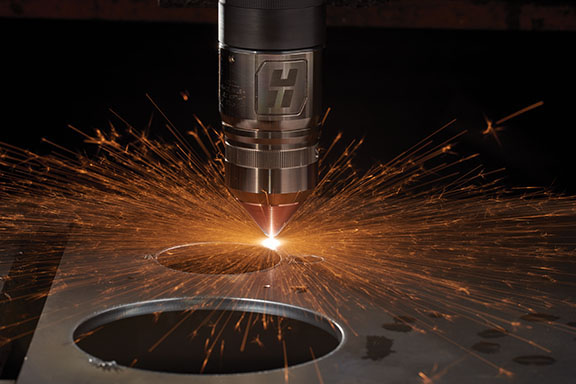
Hypertherm XPR systems are designed to deliver consistent edge quality through improved arc control and system integration.
The result is:
-
Lower dross levels
-
Improved edge uniformity
-
Reduced variability across consumable life
This consistency is what enables weld-ready performance in production environments.
Follow cut charts precisely
Cut charts are engineered to balance speed, quality, and consistency.
They define:
-
Amperage
-
Travel speed
-
Torch height
-
Gas selection
Deviating from these parameters introduces variability. Following them ensures the system performs as designed.
Select the correct process gas
Gas selection has a direct impact on weld readiness.
Oxygen is the preferred option for carbon steel when a clean, weld-ready edge is required.
Other materials require different gases, and operators should align process selection with welding expectations.
Maintain consumables for consistent performance
Consumable wear affects arc stability and cut quality.
Hypertherm systems are designed to maintain consistent performance over the life of the Hypertherm genuine consumables, but inspection and timely replacement are still critical to maintaining weld-ready edge quality.
Consistency is not just about the system. It is about maintaining the system in a controlled state.
Optimize pierce location and lead-ins
Pierce and lead-in locations affect localized edge quality. Placing them outside of weld zones preserves edge integrity and maintains consistent results.
Applications Where Weld Readiness Is Critical
Bevel cutting for weld joint preparation
Hypertherm plasma systems integrate bevel cutting directly into the CNC process. This eliminates secondary beveling steps and produces consistent weld-prep geometry in a single operation.
Plasma gouging for weld preparation
Hypertherm XPR systems support automated gouging processes that produce clean, consistent groove profiles. In many cases, these profiles can move directly to welding (or significantly reduces the time to get here) with little or no cleanup.
Flush cutting for attachment removal
Flush cutting allows attachments to be removed without damaging the base material. This reduces or eliminates grinding and preserves part quality.
The Bottom Line
Weld readiness is not created at the grinding station. It is built into the cutting process.
Hypertherm plasma cutting systems, especially high-definition platforms like XPR, are designed to deliver the consistency required to achieve this. By combining system capability with disciplined process control, fabrication shops can reduce variation, improve throughput, and minimize non-value-added work.
The result is not just cleaner cuts. It is a more predictable and repeatable production process.
Frequently Asked Questions
Q: What is a weld-ready edge in plasma cutting?
A: It is a cut edge that can be welded immediately without grinding, dross removal, or additional preparation.
Q: Can Hypertherm plasma systems consistently produce weld-ready edges?
A: Yes. High-definition systems such as Hypertherm XPR are designed to produce consistent, high-quality edges that often require little or no secondary cleanup.
Q: What prevents plasma cuts from being weld ready?
A: Common factors include dross formation, improper parameters, gas selection, consumable wear, and inconsistent cut geometry.
Q: Why is consistency important in weld-ready cutting?
A: Consistency ensures each part meets the same edge quality standard, reducing variation in fit-up and weld results.
Q: What gas is best for weld-ready carbon steel cutting?
A: Oxygen plasma typically produces the cleanest and most weld-friendly edges.
Q: How do shops reduce grinding in production?
A: By using high-definition plasma systems, following cut charts, maintaining consumables, and optimizing process parameters for consistent edge quality.
Related products

XPR170 plasma cutting system
The XPR170® mechanized plasma cutting system delivers next generation X-Definition® processes from very thin up to mid-range thicknesses.

XPR300 plasma cutting system
Cut faster and use fewer consumables with the XPR300® mechanized plasma cutting system. With unmatched X-Definition® cut quality on mild steel, stainless steel and aluminum, the XPR300 increases cut speed, dramatically improves productivity and slashes operating costs.

XPR460 plasma cutting system
Part of the Hypertherm XPR® family, the XPR460 delivers the most consistent cut quality, thicker cutting capability, and faster cutting speeds in its class—increasing productivity and lowering operating costs.