Plasma Cutting: A Modern Solution for Safer, Faster Foundry Degating & Cast Trimming
by
Plasma Cutting: A Modern Solution for Safer, Faster Foundry Degating & Cast Trimming
For more than 6,000 years, foundry casting has shaped the tools, components, and structures that support societies around the world. From early bronze tools to the complex aluminum and iron castings used in today’s vehicles, machinery, and infrastructure, foundries have always balanced tradition with innovation. Despite massive progress in materials, process control, and automation, the foundry floor remains a demanding environment.
Within this environment, manual degating and cast trimming have long stood out as two of the most challenging and hazardous tasks. Using hammers, band saws, chop saws, cutoff wheels, and grinders, workers face risks ranging from burns and lacerations to repetitive‑strain injuries and impact hazards. In many facilities, aging tooling, inconsistent part fit-up, and shrinking labor pools further complicate the process. Foundries also contend with part variability and movement, floor space constraints, and occasional part damage or contamination due to lubricants and handling.
Yet at the center of all this complexity, the core steps of casting remain unchanged: molten metal is poured into molds, cooled, and refined into its final form. Cast trimming and degating (the removal of excess material, gates, and sprues) are essential finishing steps that ensure a part is ready for downstream machining, inspection, or assembly.
Why Plasma Cutting Is Transforming Foundry Finishing
Plasma cutting has rapidly emerged as a high‑performance alternative for foundries looking to improve speed, precision, and safety in both degating and trimming operations. Unlike mechanical tools that rely on contact force, plasma uses a focused jet of ionized gas to melt and remove metal cleanly. This gives plasma several inherent advantages:
-
Fast cutting speeds across a wide range of conductive metals
-
Minimal distortion because there is no mechanical loading
-
No preheat required, enabling trimming while castings are still hot
-
Consistent quality even on variable or uneven surfaces
-
Built‑in safety benefits by reducing operator contact with high‑risk tools
Plasma excels with materials common to foundry applications: steel, stainless, cast iron, aluminum, copper, and alloys. This versatility makes it especially valuable in high‑mix environments or facilities producing both legacy and next‑generation cast components.
Powermax SYNC: Raising the Standard for Productivity and Operator Safety
The Hypertherm Powermax SYNC brings additional advantages tailored to foundry use. These systems feature:
-
No‑touch cutting, dramatically reducing ergonomic strain
-
Fast hot‑cut capabilities, allowing operators to degate immediately after shakeout
-
Simplified setup and consumables, thanks to single‑piece SYNC cartridges
-
Digital communication between cartridge and power supply, ensuring optimal settings
Where manual degating might require multiple tools, plasma condenses the process into a single, controlled operation. By minimizing time spent handling sharp flash, brittle gates, or unstable castings, foundries can both accelerate production and reduce injuries.
Productivity Advantage: Faster Flow and Better Material Recovery
One of plasma’s biggest advantages of operating is its ability to accelerate part flow. Because it doesn’t require castings to cool before cutting, plasma allows excess material to be removed and returned to the furnace more quickly. This reduces energy use, shortens loops in the melt‑return cycle, and contributes directly to lower operating costs.
Additionally:
-
Plasma significantly reduces scrap caused by tool collisions or misalignment.
-
Cuts are cleaner and more consistent, reducing or eliminating secondary grinding.
-
Variations in casting geometry are easily handled thanks to plasma’s generous standoff distance.
These improvements are especially valuable for aluminum foundries, where scrap and rework carry higher material and handling costs.
Outgrowing the Trim Press: Why Manufacturers Are Switching to Plasma
Many foundries still rely on trim presses, which can be effective but come with notable limitations:
-
They require expensive dies and ongoing tooling adjustments.
-
Even slight part variations can cause jams or damaged castings.
-
They occupy significant floor space and can produce bottlenecks.
-
Mechanical forces can distort thin or complex castings.
-
Maintenance costs rise as presses age.
Plasma cutting offers a more flexible, lower‑cost, and more adaptable solution. Adjusting for variation doesn’t require new tooling. Operators or robots simply update the cut path. For high‑mix, low‑volume production, this adaptability dramatically reduces changeover time and unlocks new opportunities for efficiency.
Automation: The Future of Foundry Trimming
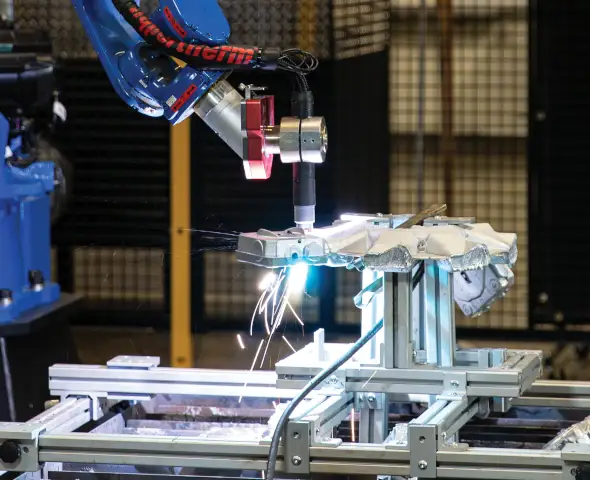
Modern foundries increasingly recognize that automation isn’t just about speed. It is also about safety, consistency, and workforce development. Plasma technology integrates seamlessly with:
-
Industrial robots
-
Collaborative robots (cobots)
-
Vision systems
Automated plasma trimming cells offer:
-
Flexible cutting paths for multiple parts and sizes
-
Reliable repeatability with minimal operator intervention
-
Smaller footprint requirements than trim presses or machining centers
-
Lower capital investment compared to laser or hydraulic systems
For many operations, automation transforms trimming and degating from a labor‑dependent bottleneck into a scalable, predictable, and continuous process.
Supporting the Workforce of Today and Tomorrow
Attracting and retaining skilled labor remains a top challenge in the foundry industry. Manual trimming roles are physically demanding, high‑risk, and often difficult to fill. By shifting these tasks to plasma‑based processes foundries create safer, more appealing roles focused on:
-
System setup and monitoring
-
Quality verification
These higher‑skill positions help build long‑term career paths while reducing injuries and turnover. Plasma technology not only modernizes production, it modernizes the workforce experience.
A Forward‑Looking Solution Rooted in Craftsmanship
Foundry casting will always remain a craft, but the tools supporting that craft are evolving. Plasma cutting provides a future‑ready solution that blends seamlessly with traditional metalworking while addressing today’s urgent needs: improved safety, predictable quality, flexible production, and long‑term resilience.
As foundries continue navigating the pressures of modernization, cost control, and labor shortages, plasma offers a way to honor the past while investing in a more efficient, adaptable, and human‑centered future. Hypertherm’s Powermax SYNC systems and robotic integration capabilities position foundries to embrace innovation without sacrificing the craft that has defined the industry for millennia.