How Anderscol Transformed Its Production with Plasma Cutting Technology
by
|
In the highly competitive construction and metalworking industry, few companies can say they have redefined their production processes with as much creativity as Anderscol Scaffolding and Structures of Colombia. Its technical manager, Alejandro Vázquez, shares a journey marked by ingenuity, strategic decisions, and real-world testing that transformed the company’s operations. From scaffolding to plasma cutting: an unexpected leapAnderscol began by manufacturing scaffolding and structures for the construction sector. In its early years, pipe cutting was performed using traditional tools, such as band saws and cutting discs. These methods got the job done, but they lacked the efficiency and quality needed to support business growth. At an industrial trade fair, Alejandro first encountered a Hypertherm® Powermax30® XP system. Although designed for cutting sheet metal, he wondered: “If it cuts sheet metal, why couldn’t it cut pipes?” That simple question sparked an internal revolution. After conducting experimental trials, including designing a machine adapted to the Powermax30, they confirmed that plasma cutting not only worked but also far exceeded expectations. Productivity multiplied The change in time-per-cut was dramatic:
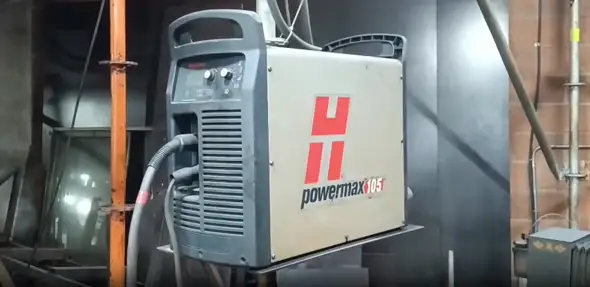
Maintenance was no longer a headache. Simply changing the nozzle was enough to keep production running. The impact was so positive that they soon upgraded to larger systems, including the Powermax45® and, later, the Powermax85®, both designed for mechanized operations. Exploring new technologiesAs Anderscol expanded its offering to include metal formwork, it became necessary to evaluate new technologies, including punching, laser cutting, and high-definition plasma cutting. While punch presses were viable, they required expensive consumables and highly specialized technicians. Laser cutting, meanwhile, promised precision and speed, at least in theory. Alejandro decided to test it himself. The plasma vs. laser race Together with a supplier partner, they conducted a real-world test: A full sheet containing 186 parts made of 3 mm steel.
Top technicians calibrated both machines. The result? Nearly identical cutting speeds. For Alejandro, the conclusion was clear: if speed was the only goal, laser was not necessarily the answer. Several factors must be considered. Quality, costs, and industrial realityAlejandro acknowledges that laser technology is unbeatable in precision. However, that precision comes with higher operating costs, controlled environments, and more delicate equipment. Plasma cutting, on the other hand,
The trade-off is slag generation, which increases post-cut finishing work, particularly on smaller parts. At Anderscol, this led to the acquisition of automatic slag-removal equipment. Plasma or laser? The decision for the next 10 yearsAccording to Alejandro, the choice depends on three key questions:
Based on these criteria, Anderscol continues to rely on plasma cutting as its core technology. A strategic partner: CodinterAlejandro closes by acknowledging the technical support received: "I would especially like to thank Codinter and Walter, with whom we conducted the first trials using the Powermax30. The technical support, warranties, and service have been excellent." |