Ultimate Guide to Cutting Aluminum with Plasma
Aluminum is a core material across fabrication, shipbuilding, transportation, and general manufacturing. It is lightweight, conductive, and common on CNC tables, but it does not behave like steel when you cut it. High thermal conductivity, a lower melting point, and relative softness mean aluminum rewards disciplined parameter control and punishes shortcuts, especially when working with Hypertherm plasma systems.
Hypertherm Plasma builds systems for that reality: high speed cutting, repeatable cut quality, and practical control over the variables that determine what happens at the edge. Plasma is not the right tool for every aluminum job, but when throughput, uptime, and production efficiency are the priorities, it is often the most productive method available.
In this guide, we’ll cover:
-
Why aluminum is well suited to plasma cutting
-
How aluminum behaves under a thermal cutting process
-
How to choose a gas process based on thickness and finish requirements
-
How to use validated cut charts as a baseline, then fine tune safely
-
What to change first when cut quality slips
-
When a non-thermal process is a better fit for the application
Why aluminum is well suited for plasma cutting
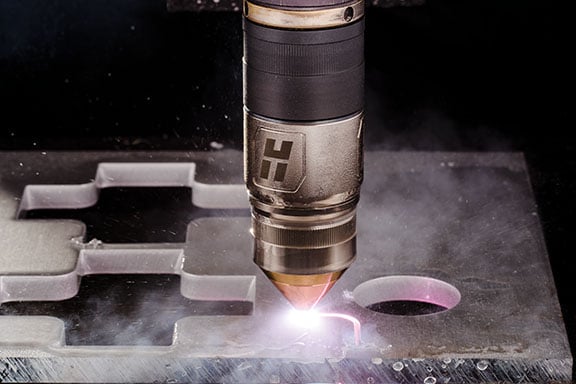
Plasma cutting uses a high velocity jet of ionized gas to melt electrically conductive metal and eject it from the kerf, a process refined across Hypertherm systems.. Aluminum is electrically conductive, so it is inherently compatible with plasma cutting.
The practical advantage is productivity, especially when using Hypertherm plasma systems designed for consistent output. Plasma can deliver high travel speeds on aluminum sheet and plate while maintaining edge quality that works for many fabrication workflows.In automated environments, Hypertherm plasma systems support repeatability by keeping torch height, speed, and sequencing consistent across long production runs.
Plasma is not universally better than other methods. It is effective because it aligns with specific production goals, especially speed, throughput, and efficient material removal.
How aluminum behaves during plasma cutting
High thermal conductivity
Aluminum moves heat away from the cut zone quickly. That pushes the process toward faster travel speeds to maintain a stable cut and avoid dumping excess heat into the workpiece. If the torch moves too slowly, heat spreads laterally into the plate. That can increase warping, distortion, and bottom edge dross.
In practical terms, travel speed is one of the first levers to check when aluminum cut quality is inconsistent.
Lower melting point
Aluminum melts at a lower temperature than steel. This helps plasma cut efficiently, but it also means excess heat input can widen the kerf, round edges, and destroy fine detail. Amperage and speed must be balanced together, with Hypertherm systems providing the control needed to maintain that balance. Increasing power without adjusting speed often pushes the cut toward a wider kerf and more cleanup.
Softness and dross sensitivity
Aluminum is relatively soft and sensitive to parameter drift. Bottom edge dross is one of the most common issues operators see. In many cases, stubborn dross is not a hardware problem. It is a speed, gas, or height problem that can be corrected with small, controlled changes.
Where plasma cutting aluminum excels
Hypertherm Plasma cutting aluminum is typically the right choice when your priority is production speed and throughput on thin to medium thickness material.
Strong use cases include:
-
High volume production cutting where cycle time matters
-
Structural and fabrication parts where a small heat affected zone is acceptable
-
CNC table cutting where lead ins, lead outs, and sequencing are standard practice
-
Automated and robotic environments where repeatability is required
Plasma also performs well when the downstream process can tolerate a thermal edge, for example when light cleanup is acceptable or when welding prep includes normal surface preparation steps.
When plasma is not the best choice
Plasma is a thermal process. Heat is part of the method. Some aluminum applications cannot tolerate that heat input.
Plasma is often not the best choice when:
-
The application requires eliminating heat affected zones
-
Flatness and distortion control are critical on thin sheet
-
Very thick aluminum plate must be cut without thermal side effects
-
Mixed or stacked materials must be cut in a single operation
In those cases, a non-thermal process, like those provided by OMAX Waterjets, can be a better fit. The goal is not to force plasma into every job. The goal is to use plasma where it is strongest and avoid rework where another method is better suited.
Gas selection for plasma cutting aluminum
Gas choice has a direct impact on cut speed, edge appearance, dross formation, and operating cost. Selecting the correct process is one of the fastest ways to improve aluminum results without changing equipment.
Gas process selection by thickness and finish target
| Thickness and finish target | Typical process direction | Why it is used |
| Thin aluminum where cost and speed dominate | Compressed air | Accessible and economical, good speed, edge may show more oxidation and may need light cleanup before welding |
| Thin aluminum where the edge finish is the priority | Nitrogen based process | Cleaner edge appearance and reduced oxidation relative to air, often reduces cleanup time |
| Medium thickness aluminum balancing finish and operating cost | Nitrogen with enhanced shielding approach | Improves edge condition while maintaining high production speed |
| Thick aluminum plate where edge quality is non negotiable | Argon hydrogen blend on mechanized systems | High energy process for thick plate, chosen when finish and cut quality justify the process complexity |
The correct choice depends on what you are optimizing for. If the part is going to welding, edge chemistry and cleanup time matter more. If the part is strictly structural and going to a secondary operation anyway, speed and cost may dominate.
The baseline that prevents most aluminum cut problems: validated cut charts
The most reliable starting point for aluminum cutting is the validated cut chart data supplied for your specific system, consumables, and gas process. Cut charts are built from testing. They provide baseline values for amperage, gas pressures, travel speed, pierce height, and cut height.
The reason cut charts matter is simple. Plasma cutting has a process window. Inside that window, you get stable arc behavior and predictable edges. Outside that window, you chase symptoms and waste consumables. Starting with validated data keeps you in the window.
Dialing in the cut: the variables that matter most
Amperage and travel speed are linked
Amperage provides cutting power. Travel speed controls heat input. These two variables have to move together.
Common failure modes are predictable:
-
Too slow: excessive heat input, wide kerf, heavy bottom edge dross, distortion
-
Too fast: incomplete penetration, bevel, arc instability, spatter
A practical tuning approach is to start at the validated speed, then adjust in small increments until dross is minimized and the edge profile stabilizes. Avoid large swings. If you need large swings, the process selection is likely wrong for the thickness or finish target.
Torch height control and piercing discipline
Torch height control is not optional if you want repeatability on aluminum. Height affects arc shape, kerf geometry, and edge angularity.
Piercing is a separate event from cutting. Piercing should occur at a higher height than the cut height to protect consumables from molten splashback. After piercing, the system transitions to the correct cut height for steady state cutting.
If pierce height is too low, you shorten consumable life and introduce cut instability. If cut height is wrong, edge quality and dross will follow.
Work clamp quality and electrical stability
Aluminum cutting requires a stable electrical circuit. A weak work clamp connection can present as inconsistent cut quality, arc instability, or unexplained defects.
Best practice is to attach the work clamp to clean material and maintain a consistent connection point. If you are cutting on a table where the clamp is moved frequently, treat clamp placement and surface preparation as part of setup, not as an afterthought.
Best practices that improve aluminum cut quality without slowing production
These are process habits that reduce rework and improve consistency without adding meaningful cycle time.
-
Keep pierces off finished edges by using lead ins and lead outs. The pierce event is usually the messiest part of the cut. Put it in scrap.
-
Use stable fixturing. Movement during cutting will ruin accuracy and can create edge defects that look like parameter issues.
-
Manage thin sheet distortion with sequencing, heat distribution, and tabs when appropriate. Aluminum moves when it heats. Plan for that.
-
Maintain consumables proactively. Consumables do not usually fail all at once. They drift. Replace them before drift becomes rework.
In production environments, these habits matter because they reduce secondary operations. Cleanup, grinding, and rework are where profitability goes to die.
Graph: choosing plasma vs a non thermal process for aluminum
This table is designed as a decision aid, not a marketing comparison.
| Requirement | Plasma cutting | Waterjet cutting |
| Maximum cutting speed on thin aluminum | Strong fit | Moderate fit |
| High volume production throughput | Strong fit | Moderate fit |
| Thick aluminum plate with minimal thermal impact | Limited fit | Strong fit |
| Eliminating heat affected zones | Weak fit | Strong fit |
| Flatness and distortion control on thin sheet | Moderate fit | Strong fit |
| Mixed materials or stacked cutting | Poor fit | Strong fit |
| Minimizing secondary finishing | Sometimes | Often minimal |
Use this table as a quick check. If your top requirements cluster on the right column, forcing plasma into that job usually costs more than it saves.
Troubleshooting common aluminum cut issues
Use this as a fast diagnosis table. The goal is to correct the process variable, not to guess.
| Issue | Common cause | Typical correction |
| Heavy bottom edge dross | Travel speed too slow | Increase speed in small increments until dross reduces or flakes off easily |
| Rough, sooty, or oxidized edge | Incorrect gas choice or contaminated air | Verify gas process selection and confirm the supply is clean and dry |
| Warping and part distortion | Excessive heat input | Increase speed or reduce amperage, manage heat with sequencing or a water table if available |
| Wide kerf and poor detail | Amperage too high | Select a lower amperage process and use fine cut consumables when appropriate |
| Bevel or angular edge | Height or speed out of the process window | Verify cut height, then confirm speed matches the selected process |
| Short consumable life | Pierce height too low or poor piercing practice | Increase pierce height and confirm the pierce to cut transition is correct |
If the issue persists after one change, revert to baseline parameters and change one variable at a time. Aluminum will punish stacked changes because you cannot tell which change caused the outcome.
Automation and repeatability
CNC and robotic plasma cutting systems improve aluminum results by reducing variability. Height control, speed control, lead ins, lead outs, and sequencing become repeatable. That is why automated plasma performs so well in high volume environments.
Automation does not fix bad parameters. It enforces whatever parameters you feed it. If the process is correct, automation amplifies good results. If the process is wrong, automation produces consistent defects at high speed.
The best automation strategy is to standardize:
-
Validated process selection for common thickness ranges
-
Baseline cut charts for each system and consumable set
-
Lead in, lead out, and pierce placement standards
-
Consumable inspection and replacement triggers
This approach reduces scrap and shortens the time between a process drift and a correction.
Frequently asked questions
Q: Can plasma cut aluminum cleanly?
A: Yes. Clean cuts depend on selecting the correct gas process, starting from validated cut parameters, and maintaining stable torch height and travel speed.
Q: Is plasma faster than a non-thermal process for aluminum?
A: On thin aluminum, plasma is typically much faster. On thick plate or heat sensitive applications, a non-thermal process can be more practical overall.
Q: Does plasma cutting affect aluminum properties?
A: Plasma introduces heat and can create a heat affected zone. Whether that matters depends on the application and downstream requirements.
Q: What improves aluminum cut quality most quickly?
A: Start from validated cut parameters, then adjust travel speed and gas selection in small increments. Those two factors often have the fastest impact on dross and edge appearance.
Q: What should operators avoid when cutting aluminum with plasma?
A: Avoid drag cutting aluminum and avoid piercing at the cut height. Use a controlled standoff and pierce higher than the cut height to protect consumables and stabilize the cut.